Machines at the Margin: How Trading Bots Are Quietly Winning the Token Price Discovery War
In traditional financial markets, the phrase "price discovery" implies a reasonably transparent process — buyers and sellers negotiate value through open competition until a consensus price emerges. In cryptocurrency markets, that process has been fundamentally altered. Across both decentralized exchanges (DEXs) and centralized platforms (CEXs), a growing share of price-setting activity now happens in intervals measured in milliseconds, executed entirely by automated scripts that retail participants cannot outpace, outspend, or reliably anticipate.
The implications for everyday crypto investors are significant. What appears on a price chart as organic movement often reflects the residue of bot-driven arbitrage cycles that completed long before a human trader could have placed an order. This is not a fringe concern. It is the structural reality of how modern token markets function — and recognizing it is the first step toward navigating it intelligently.
How Bot Arbitrage Actually Works
At its core, arbitrage is simple: buy an asset where it is cheaper, sell it where it is more expensive, and capture the spread. What bots have done is compress the time required to execute this strategy to near-zero while simultaneously expanding the number of venues monitored and the sophistication of the logic applied.
A typical DEX arbitrage bot monitors price feeds across multiple liquidity pools — Uniswap, Curve, SushiSwap, and others — simultaneously. When a large retail trade shifts the price on one pool, the bot identifies the resulting discrepancy against another venue within the same block or the next one, submits a corrective trade, and pockets the difference. This process, known as atomic arbitrage, can occur entirely within a single Ethereum block, meaning the entire cycle — detection, execution, and profit extraction — completes in under twelve seconds.
More aggressive variants operate through a mechanism called Miner Extractable Value (MEV), now commonly referred to as Maximal Extractable Value. Here, bots do not merely react to price discrepancies — they actively reorder, insert, or suppress transactions in the mempool to manufacture favorable conditions. Sandwich attacks represent the most well-known MEV strategy: a bot detects a pending large buy order, front-runs it with its own purchase to push the price up, allows the victim's trade to execute at a worse rate, then immediately sells into the elevated price. The retail trader absorbs the slippage; the bot captures the spread.
On centralized exchanges, latency arbitrage is the dominant strategy. Bots co-located with exchange servers react to price changes on reference markets — typically Binance or Coinbase — and update orders on smaller CEXs before those platforms' own matching engines have fully processed the new information. Retail traders posting limit orders on mid-tier centralized exchanges are frequently trading against stale prices that bots have already repriced.
Which Tokens Face the Greatest Exposure
Not all tokens are equally vulnerable. Bot activity concentrates where conditions are most favorable for consistent extraction, and several token characteristics reliably attract automated attention.
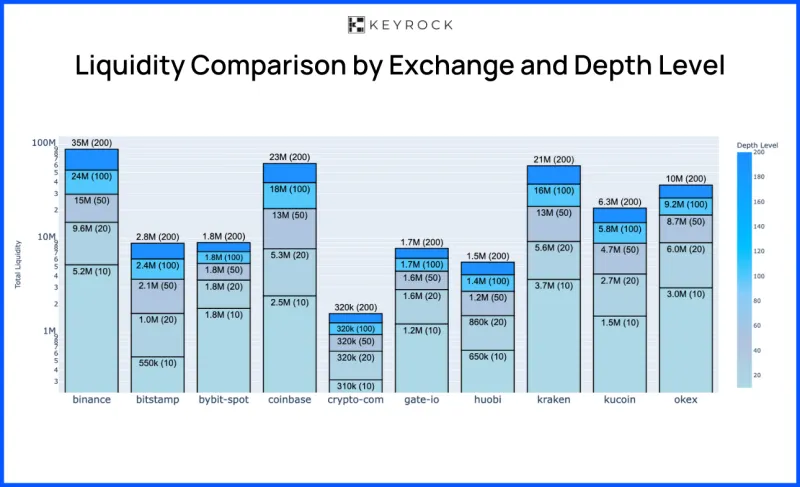
Low-liquidity tokens on DEXs are primary targets. Thin liquidity pools mean that even modest trade sizes produce significant price impact, creating arbitrage gaps that bots can exploit repeatedly. A token with a $200,000 liquidity pool will experience far more bot-driven price oscillation than one with $20 million in depth.
Newly listed tokens — particularly those launching on DEXs before achieving CEX listings — operate in an information-asymmetric environment where price discovery is entirely bot-mediated during the critical early hours. The initial price established for many new tokens reflects bot competition more than genuine market consensus.
Tokens listed across multiple chains or bridges present persistent cross-venue discrepancies. When a token trades on both Ethereum and Arbitrum, for example, price differences between the two environments are continuously harvested by bots monitoring bridge activity and cross-chain liquidity.
High-volatility periods amplify bot activity universally. During sharp market moves, the frequency and scale of arbitrage opportunities expand dramatically, and bot transaction volume as a share of total on-chain activity can exceed sixty to seventy percent on some DEXs.
The Retail Experience: What You're Actually Seeing
For a retail investor reviewing a token's price chart or order book, bot activity creates several misleading signals worth understanding.
First, apparent liquidity is frequently overstated. Order books on CEXs are populated in part by market-making bots that withdraw their quotes the moment a large order approaches, a behavior that makes depth appear greater than it functionally is during normal conditions. Under stress, that liquidity evaporates faster than the display suggests it will.
Second, price stability in low-volume periods can mask underlying fragility. When bots maintain tight spreads during quiet trading sessions, the appearance of stability may reflect automated equilibrium rather than genuine buyer-seller balance. A single large organic order can disrupt that equilibrium sharply.
Third, transaction confirmation delays expose retail traders disproportionately. A retail user submitting a market buy on a DEX during a period of network congestion may see their transaction execute at a materially different price than the one displayed at submission — not because of random slippage, but because bots have repositioned around their pending order during the confirmation window.
Practical Approaches for Retail Participants
Acknowledging the structural disadvantage is not the same as accepting defeat. Several concrete practices can reduce a retail trader's exposure to bot-driven price traps.
Set tight slippage tolerances on DEX trades. Most decentralized exchange interfaces allow users to specify a maximum acceptable slippage percentage. Keeping this figure low — typically one percent or below for liquid tokens — reduces the profitability of sandwich attacks against your transactions. The tradeoff is a higher rate of failed transactions during volatile periods, which is a worthwhile cost.
Use limit orders on CEXs rather than market orders. Market orders on centralized exchanges are the most exposed to latency arbitrage, as they accept whatever price the matching engine assigns at the moment of execution. Limit orders define your acceptable price explicitly and prevent bots from filling you at an unfavorable rate.
Evaluate token liquidity depth before trading. Before entering a position in any token, examine the liquidity pool size on relevant DEXs or the order book depth on CEXs at meaningful price increments. Avoid tokens where your intended trade size represents more than one to two percent of available liquidity — the price impact at that scale creates an immediate arbitrage opportunity against you.
Be cautious during high-congestion network periods. On-chain activity metrics and gas price trackers can indicate when Ethereum or other networks are under congestion stress. Executing DEX trades during these windows increases the probability of MEV exploitation due to longer mempool exposure.
Consider MEV-protected transaction routing. Services such as Flashbots Protect and similar private transaction relays submit orders directly to block builders without broadcasting to the public mempool, substantially reducing sandwich attack exposure. These tools are increasingly accessible to retail users through wallet integrations.
Accepting the Structural Reality
The bot arbitrage ecosystem is not going away. If anything, it is becoming more sophisticated as competitive pressure drives developers to refine their strategies and invest in faster infrastructure. For retail crypto participants in the United States — operating without co-location advantages, institutional data feeds, or custom smart contract tooling — the priority is not to compete with automated systems but to avoid the specific situations where those systems extract value most aggressively.
Price discovery in token markets has been partially ceded to machines. Understanding which corners of the market they dominate most completely is what separates an informed participant from an uninformed one — and in crypto markets, that distinction consistently determines who captures value and who provides it.